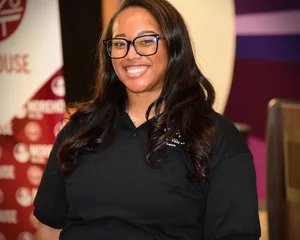
Why I Stopped Calling Myself “Just” a College Counselor
Last time we talked, I told you that I consider myself a generalist and not a specialist. I think generalists are important because it signals multifaceted living and experience. Counselor. Strategist. Creator. What most people think is that you have to live in one lane, and within that lane you must hold one title. But if my first group of students taught me anything, it was that being multifaceted and not holding on to just one title actually prepares you for more—while also helping you realize that you can have multiple interests.
For me, holding different titles, including wife and mother, are important to me. And it's important because it signals that I am not a monolith. For years, the Black woman has been told that she must be this one type of thing in order to be deemed acceptable by society. But honestly, that's old, tired, and downright disrespectful. I believe that in 2020 we saw a shift. We saw a shift away from just being this one type of thing. While social media was the avenue through which a lot of information was being shared, it also highlighted that people were multifaceted—especially Black women. I remember joining a group that really enjoyed CrossFit. There was once a time in my life where I was the avid 5 AM CrossFit girl, and you could not tell me that CrossFit was not influential to me. In a lane where training and fitness felt scarce, I found something that gave me community in a new space, in a new chapter of my life.
When I first stepped foot into a classroom, I realized that these 14- and 15-year-olds looked up to a fresh-out-the-gate 22-year-old. Unlike some of my coworkers, I understood that where I was teaching held very few Black female teachers who weren't perpetuating stereotypes and assuming these kids weren't capable. One of my most authentic statements from my classroom: "Y'all don't scare me. I'm from Atlanta." Some of my favorite students (they weren't my favorites out loud back then) used to chuckle, because they knew—I'm professional, but don't play with me. I was very authentic in my classroom, and would tell them, you might be required by law to be here, but those policies did not include being rude or making everyone else have a miserable day. I held high expectations, but knew sometimes we needed a Disney playlist or a walk outside—shoutout to the school having gated campus greenery. Coming back to Atlanta post-pandemic, I kept the same energy. My students learned and were held to high standards, but my 3rd period was always excited to watch a new Disney series during lunch. I was still myself in the swim lane of teacher, and as a college counselor, we had real conversations. My kids can't tell you that I didn't try to teach them personal finance before leaving, because I have their assignments to prove that we went beyond what was required of me as an educator.
I am a creator—maybe not how people think about it in the traditional sense. I create structure in the most ambiguous places, and my communication skills became so good at that very thing that it landed me in project management.
That same intellectual curiosity is what keeps me looking under the hood in project management. I'm never satisfied with a system that just works—I want to know why it works, where it breaks, and who it leaves behind. So I build strategies designed to sustain at least 90% of the team, regardless of generation. Because a system that only works for the people who think like me isn't a strong system; it's a fragile one. Whether it's a Boomer who prefers a printed checklist or a Gen Z teammate who lives in their notifications, the goal is the same: build something that holds, no matter who's holding it.
1 Peter 4:10–11 (CSB): "If anyone speaks, let it be as one who speaks God's words; if anyone serves, let it be from the strength God provides, so that God may be glorified through Jesus Christ in everything. To him be the glory and the power forever and ever. Amen."
What is the point I'm really trying to make? You cannot put me in a box. Honestly, I couldn't put myself in one if I tried, because God himself said I was to operate this way—to touch the lives of others in unconventional ways. I stopped subscribing to being just whatever identity; it took too much out of me to try to pin myself down. God made me intellectually and socially curious. I'll continue to be that way.